Fit a normal-block model with a variational or heuristic algorithm
Usage
normal_block(
  data,
  blocks,
  sparsity = 0,
  zero_inflation = FALSE,
  control = NB_control(),
  model = c("var", "mean")
)
Arguments
- data
NormalBlockData object, contains the matrix of responses (Y, n x p) and the design matrix (X, n x d), must be created with NormalBlockData$new.
- blocks
either a integer (number of blocks), a vector of integer (list of possible number of block) or a p * q matrix (for indicating block membership when its known)
- sparsity
either TRUE to run the optimization for different sparsity penalty values OR float to run model with a single sparsity penalty value
- zero_inflation
boolean to indicate if Y is zero-inflated and adjust fitted model as a consequence
- control
a list-like structure for detailed control on parameters should be generated with NB_control().
- model
which model family to fit: "var" (the default) structures the clustering in the latent covariance (see [NormalBlockVarBase]), "mean" structures it in the mean (mu_i = C B' X_i, see [NormalBlockMeanBase]). The mean-block family covers the same collections as the variance-block one ([NormalBlockMeanCollectionClusters], [NormalBlockMeanCollectionSparsity] and their crossing, [NormalBlockMeanCollectionClustersSparsity]) – each q simply fit independently, without the variance-block family's SBM-path shortcut. Zero-inflation is supported ([ZINormalBlockMeanKnownClusters], [ZINormalBlockMeanUnknownClusters], and collections of those over a range of q), with a diagonal or spherical Sigma only, hence not along a sparsity path – see [NormalBlockMeanBase].
Examples
## Normal Data
ex_data <- generate_normal_block_var_data(n=100, p=30, d=1, q=3)
data <- NormalBlockData$new(ex_data$Y, ex_data$X)
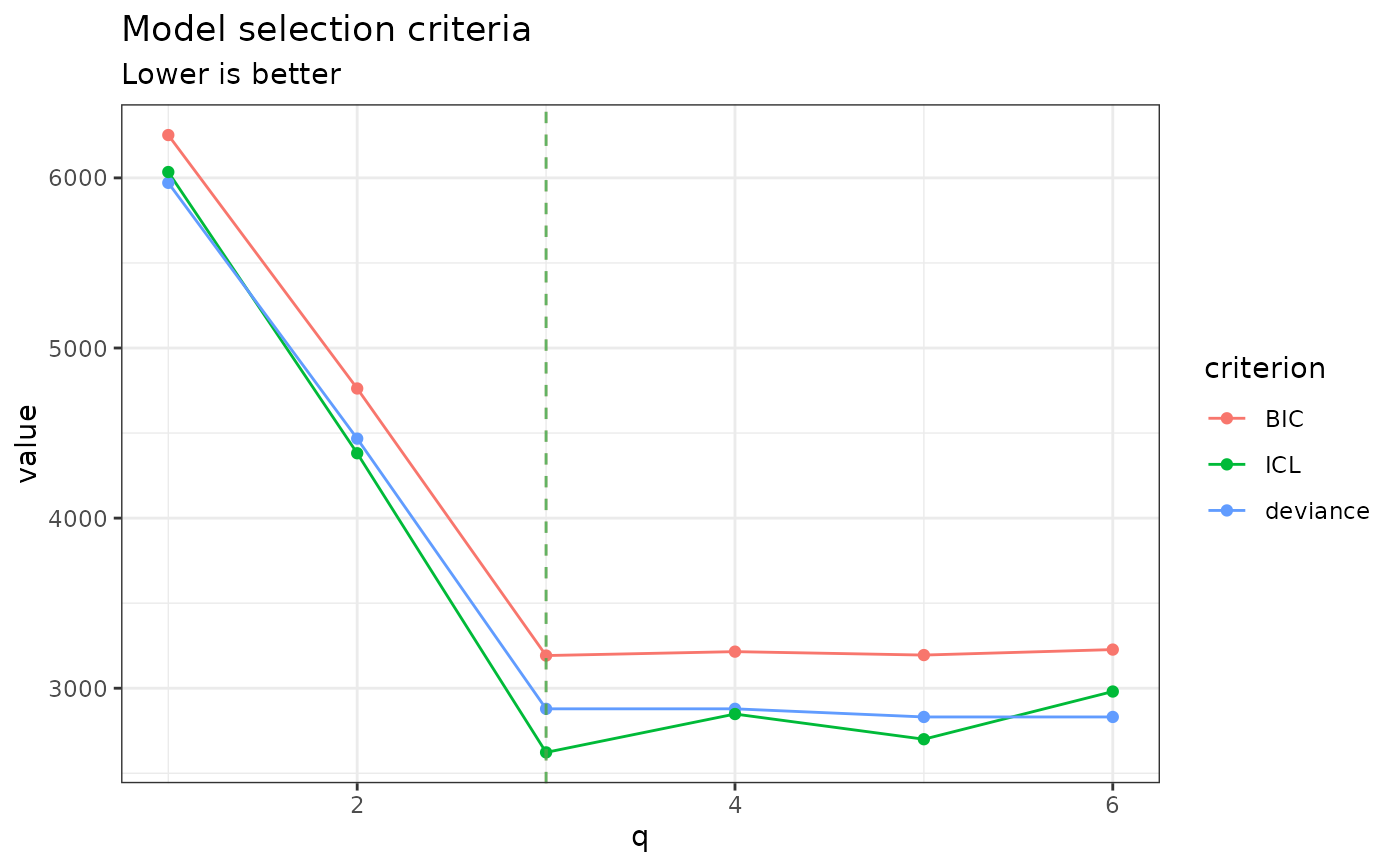
my_normal_block <- normal_block(data, blocks = 1:6)
#> Fitting a diagonal normal-block-var model with unknown q
#> number of blocks = 1
number of blocks = 2
number of blocks = 3
number of blocks = 4
number of blocks = 5
number of blocks = 6
#> DONE
my_normal_block$plot(c("deviance", "BIC", "ICL"))
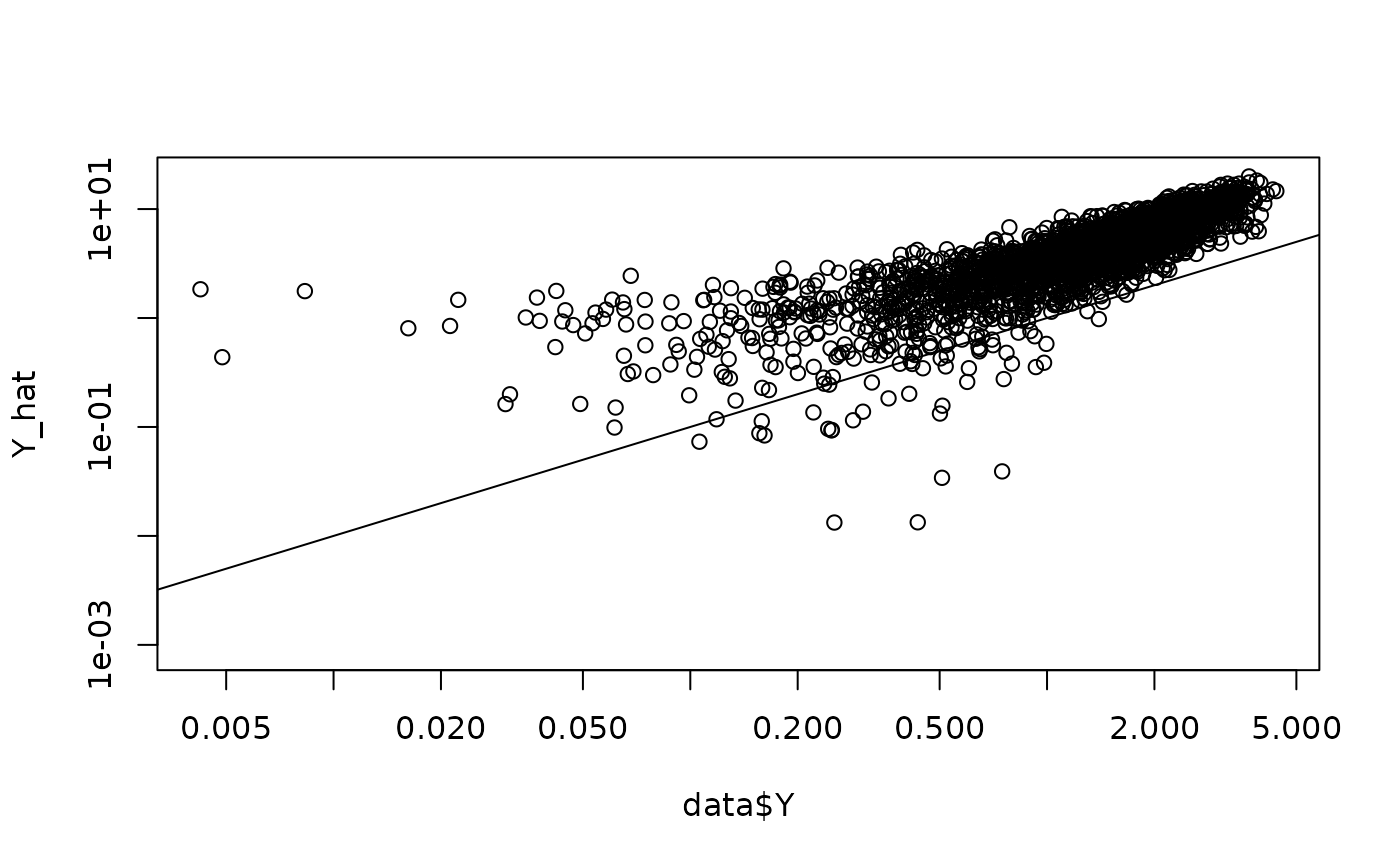
 Y_hat <- my_normal_block$get_best_model()$fitted
plot(data$Y, Y_hat, log = "xy"); abline(0,1)
#> Warning: 445 x values <= 0 omitted from logarithmic plot
#> Warning: 374 y values <= 0 omitted from logarithmic plot
Y_hat <- my_normal_block$get_best_model()$fitted
plot(data$Y, Y_hat, log = "xy"); abline(0,1)
#> Warning: 445 x values <= 0 omitted from logarithmic plot
#> Warning: 374 y values <= 0 omitted from logarithmic plot
 ## Normal Data with Zero Inflation
ex_data_zi <- generate_normal_block_var_data(n=50, p=50, d=1, q=3, kappa = rep(0.5,50))
zidata <- NormalBlockData$new(ex_data_zi$Y, ex_data_zi$X)
my_normal_block <- normal_block(zidata, blocks = 1:6, zero_inflation = TRUE)
#> Fitting a diagonal normal-block-var model with unknown q
#> number of blocks = 1
number of blocks = 2
number of blocks = 3
number of blocks = 4
number of blocks = 5
number of blocks = 6
#> DONE
## Mean-Block model (clustering in the mean rather than the covariance)
ex_mean <- generate_normal_block_mean_data(n=50, p=20, d=1, q=3)
mean_data <- NormalBlockData$new(ex_mean$Y, ex_mean$X)
my_mean_block <- normal_block(mean_data, blocks = 3, model = "mean")
#> Fitting a diagonal normal-block-mean model with 3 unknown blocks
#>
#> DONE
## Normal Data with Zero Inflation
ex_data_zi <- generate_normal_block_var_data(n=50, p=50, d=1, q=3, kappa = rep(0.5,50))
zidata <- NormalBlockData$new(ex_data_zi$Y, ex_data_zi$X)
my_normal_block <- normal_block(zidata, blocks = 1:6, zero_inflation = TRUE)
#> Fitting a diagonal normal-block-var model with unknown q
#> number of blocks = 1
number of blocks = 2
number of blocks = 3
number of blocks = 4
number of blocks = 5
number of blocks = 6
#> DONE
## Mean-Block model (clustering in the mean rather than the covariance)
ex_mean <- generate_normal_block_mean_data(n=50, p=20, d=1, q=3)
mean_data <- NormalBlockData$new(ex_mean$Y, ex_mean$X)
my_mean_block <- normal_block(mean_data, blocks = 3, model = "mean")
#> Fitting a diagonal normal-block-mean model with 3 unknown blocks
#>
#> DONE