Adjust a linear model with lasso regularization, that is a (possibly weighted) \(\ell_1\)-norm. The solution path is computed at a grid of values for the \(\ell_1\)-penalty. See details for the criterion optimized.
Arguments
- x
matrix of features, possibly sparsely encoded (experimental). Do NOT include intercept. When normalized os
TRUE, coefficients will then be rescaled to the original scale.- y
response vector.
- lambda1
sequence of decreasing \(\ell_1\)-penalty levels. If
NULL(the default), a vector is generated withnlambda1entries, starting from a guessed levellambda1.maxwhere only the intercept is included, then shrunken tominratio*lambda1.max.- penscale
vector with real positive values that weight the \(\ell_1\)-penalty of each feature. Default set all weights to 1.
- intercept
logical; indicates if an intercept should be included in the model. Default is
TRUE.- normalize
logical; indicates if variables should be normalized to have unit L2 norm before fitting. Default is
TRUE.- refit
logical: indicates if the non null coefficients should be refit to avoid excessive bias. Default is FALSE. Can be changed later (both raw and refit coefficients are stored).
- nlambda1
integer that indicates the number of values to put in the
lambda1vector. Ignored iflambda1is provided.- minratio
minimal value of \(\ell_1\)-part of the penalty that will be tried, as a fraction of the maximal
lambda1value. A too small value might lead to instability at the end of the solution path corresponding to smalllambda1combined with \(\lambda_2=0\). The default value tries to avoid this, adapting to the '\(n<p\)' context. Ignored iflambda1is provided.- maxfeat
integer; limits the number of features ever to enter the model; i.e., non-zero coefficients for the Elastic-net: the algorithm stops if this number is exceeded and
lambda1is cut at the corresponding level. Default ismin(nrow(x),ncol(x))for smalllambda2(<0.01) andmin(4*nrow(x),ncol(x))otherwise. Use with care, as it considerably changes the computation time.- beta0
a starting point for the vector of parameter. By default, will initialized zero. May save time in some situation.
- control
list of argument controlling low level options of the algorithm –use with care and at your own risk– :
verbose: integer; activate verbose mode –this one is not too risky!– set to0for no output;1for warnings only, and2for tracing the whole progression. Default is1. Automatically set to0when the method is embedded within cross-validation or stability selection.timer: logical; use to record the timing of the algorithm. Default isFALSE.maxiterthe maximal number of iteration used to solve the problem for a given value of lambda1. Default is 500.methoda string for the underlying solver used. Either"quadra","fista"or"pgd". Default is"quadra".thresholda threshold for convergence. The algorithm stops when the optimality conditions are fulfill up to this threshold. Default is1e-7for"quadra"and1e-2for the first order methods.monitorindicates if a monitoring of the convergence should be recorded, by computing a lower bound between the current solution and the optimum: when'0'(the default), no monitoring is provided; when'1', the bound derived in Grandvalet et al. is computed; when'>1', the Fenchel duality gap is computed along the algorithm.
Value
an object with class QuadrupenFit.
an object with class ElasticNetFit, inheriting from QuadrupenFit.
Note
The optimized criterion is the following:
penscale argument.
Examples
## Simulating multivariate Gaussian with blockwise correlation
## and piecewise constant vector of parameters
beta <- rep(c(0,1,0,-1,0), c(25,10,25,10,25))
cor <- 0.75
Soo <- toeplitz(cor^(0:(25-1))) ## Toeplitz correlation for irrelevant variables
Sww  <- matrix(cor,10,10) ## bloc correlation between active variables
Sigma <- Matrix::bdiag(Soo,Sww,Soo,Sww,Soo)
diag(Sigma) <- 1
n <- 50
x <- as.matrix(matrix(rnorm(95*n),n,95) %*% chol(Sigma))
y <- 10 + x %*% beta + rnorm(n,0,10)

labels <- rep("irrelevant", length(beta))
labels[beta != 0] <- "relevant"
## The solution path of the LASSO
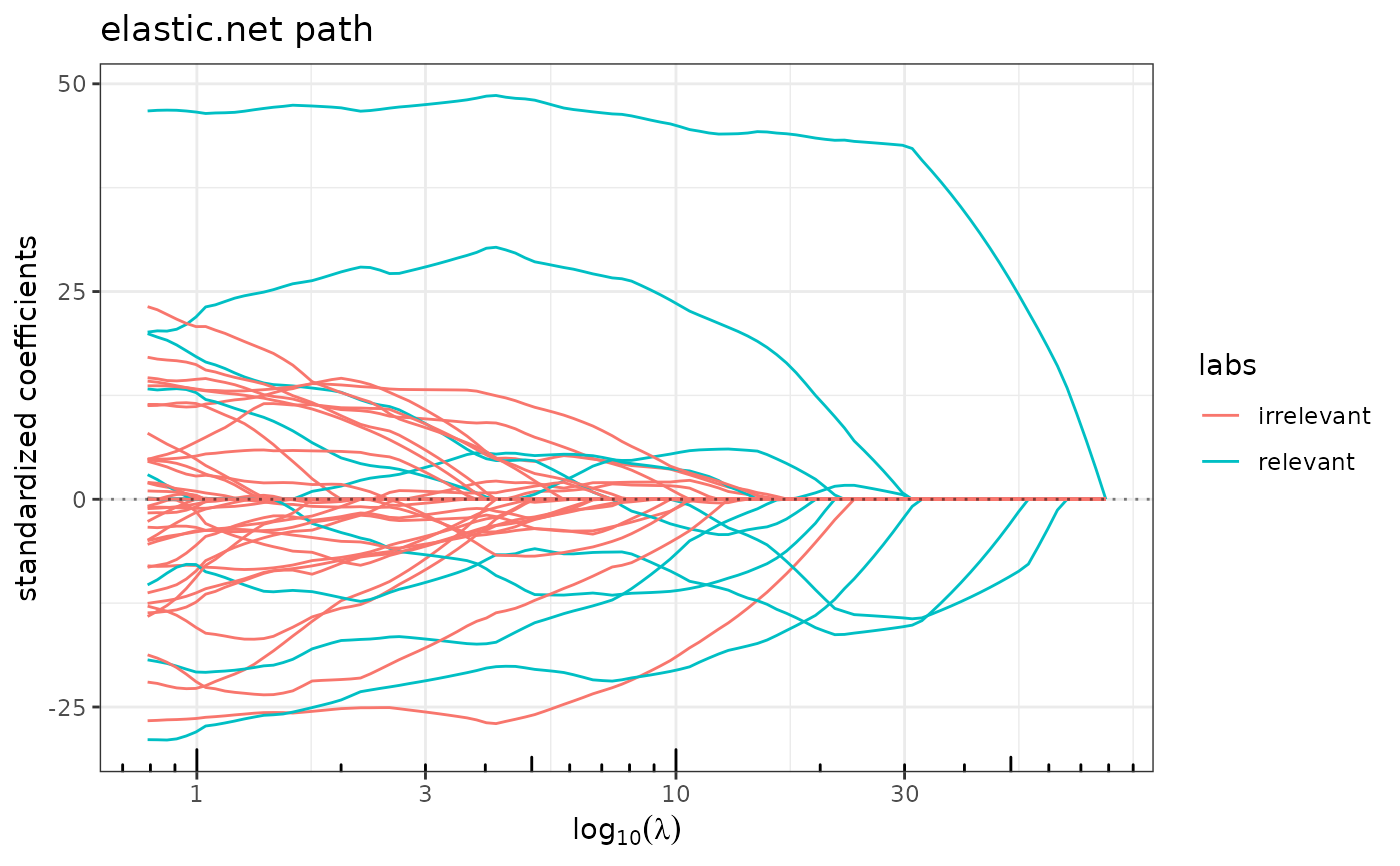
plot(lasso(x,y), label=labels)